
Talk and reading with Kook-Nam Cho-Ruwwe, Suza Husse and works of Surya Gied
The recruitment of Korean nurses, regulated by the recruitment agreement between South Korea and the Federal Republic of Germany, was officially presented as a development aid measure for South Korea. But who was actually helping whom? Asian and Korean nursing professionals made a decisive contribution to securing and developing Germany’s healthcare system. The “Korea Program” should therefore be understood rather as a form of reverse development aid for the German healthcare sector.*
Talk and reading with Kook-Nam Cho-Ruwwe, Suza Husse, and works by Surya Gied
April 28, 2022, 6:00 pm
Within the exhibition Surya Gied: Godori – Battle of Flowers (Dieter Ruckhaberle Award), curated by Suza Husse
* Kook-Nam Cho-Ruwwe, Wer sich nicht bewegt, spürt ihre Fesseln nicht, in: Encarnación Gutiérrez Rodríguez & Pinar Tuzcu (eds.), Migrantischer Feminismus in der Frauen:Bewegung in Deutschland (1985–2000), 2021, p. 120.
GalerieETAGE, Museum Reinickendorf
Alt-Hermsdorf 35 | 13467 Berlin
Kook-Nam Cho-Ruwwe came to Germany in 1970 as a qualified nurse and worked for four decades in various health and care institutions. She is a co-founder of the Korean women’s group in Germany, which emerged in 1978 from Korean women’s struggle against unequal labor and residence rights for Asian migrant workers.
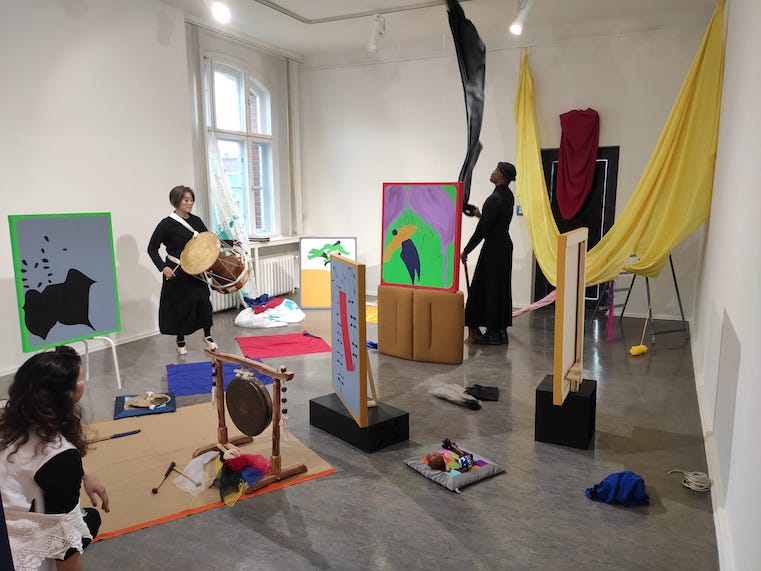
As part of Godori – Battle of Flowers, a conversation with Kook-Nam Cho-Ruwwe, curator Suza Husse, and the exhibited works by Surya Gied will take place on April 28. In this discussion, we will talk with Kook-Nam Cho-Ruwwe about the history or histories of migrant feminist organizing and solidarity in Germany and South Korea. Her reflections on the “development aid” provided by migrant culture and labor offer a powerful starting point for discussing the highly topical connections between the crisis of the healthcare system and migration policies, as well as between anti-racist struggles and global decolonial approaches. Further inspiration for the conversation comes from her text Wer sich nicht bewegt, spürt ihre Fesseln nicht in the book Migrantischer Feminismus in der Frauen:Bewegung in Deutschland (1985–2000) (eds. Encarnación Gutiérrez Rodríguez & Pinar Tuzcu, 2021), from which passages will be read.
In Godori – Battle of Flowers, Surya Gied weaves together cultural and political resonances from the intertwined life paths and migration histories of her mother and herself. Various traces of historical and contemporary living conditions and struggles of Korean labor migrants in Germany and rice farmers in South Korea condense in the exhibition into the collective biography of a house in Hwaho-ri, a small village in the south of the Korean peninsula. In doing so, the artist interlaces painterly techniques with oral history, photography, sound and video works, performance, and sculpture to create spaces and forms for multidimensional narratives.
The exhibition is part of the Dieter Ruckhaberle Award, which is granted by Künstlerhof Frohnau and which Surya Gied received in 2021. Many of the works on display were created at Künstlerhof Frohnau, located on the grounds of the former external branch of the Karl Bonhoeffer Psychiatric Clinic. As Surya Gied’s artistic research revealed over time, numerous Korean nurses also worked there until the late 1980s.
Kook-Nam Cho-Ruwwe, born in 1948 in Kimcheon, South Korea, has been actively committed for more than 40 years to the political-legal, economic, and social equality of migrant women workers in Germany and South Korea. She is a co-founder and chair of the board of DaMigra e.V. She brings her expertise as a contemporary witness and activist into various political bodies. Promoting networking and cooperation among migrant women’s organizations, as well as fostering dialogue between generations, are particularly close to her heart.
Suza Husse works collaboratively and transdisciplinarily, focusing on queer-feminist and anti-racist cultures of knowledge, political imagination, and aesthetics of transformation.