Walden: Memory Beach
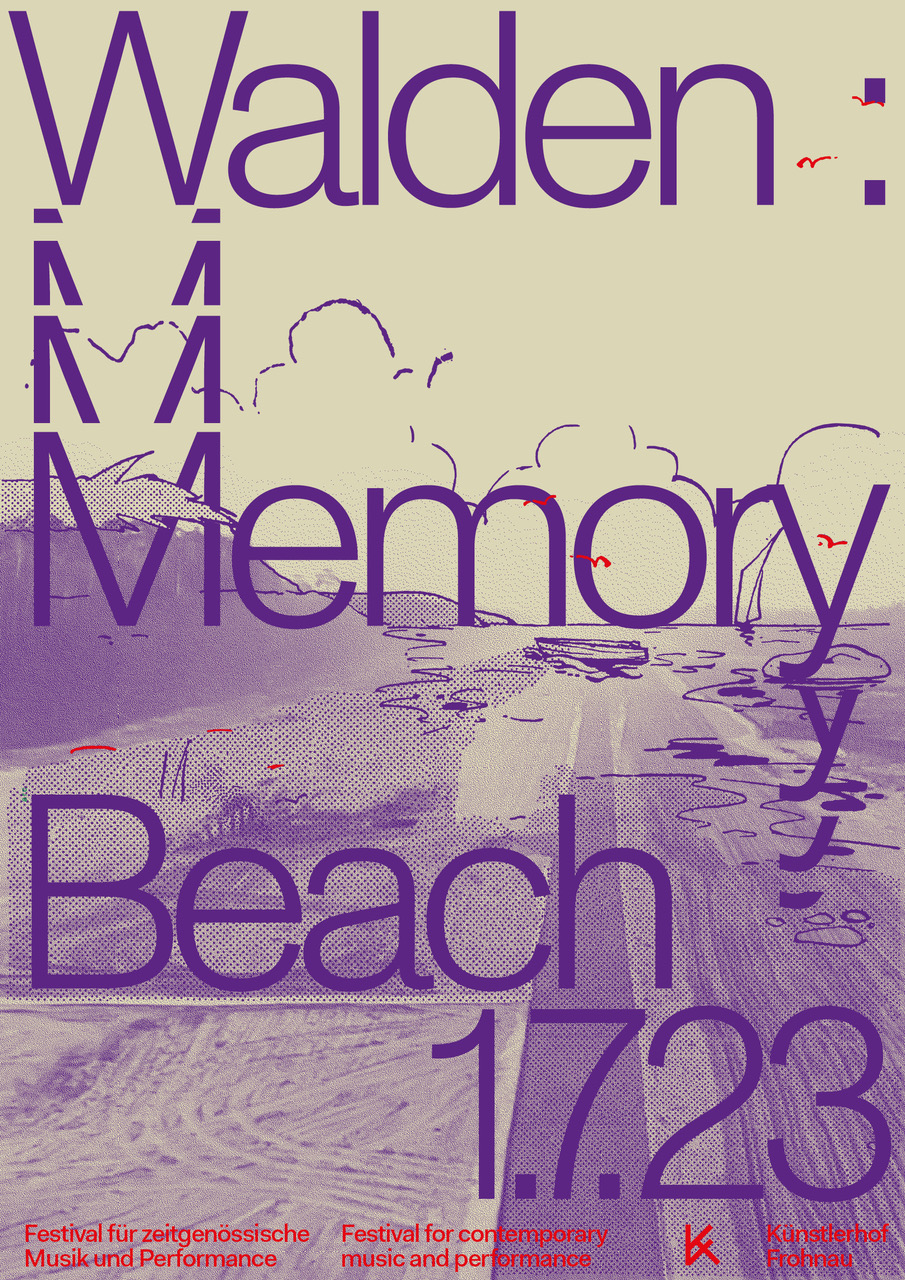
Walden: Memory Beach. Festival for Contemporary Music and Performance
Saturday, July 1, 2023, 2:00 pm–11:00 pm
At Künstlerhof Frohnau and along the former border strip. Free admission. Open air.
With performances and musical contributions by:
2_personal_things (Park Minyoung & Kim Jinhyuk)
Ashkan Sepahvand
discourse / Katayoun Arian
DJ Edna Martinez
DJ Letkidbe
Hooops / Astarte Posch
Jung Sun Kim, Matthias Erian, Ji Sun Hagen & Soomin Chae
Muriel Razavi & Raha Nejad
Nicholas Bussmann & Cottbusser Chor
Posaunenchor Hohen Neuendorf
Ray Kaczynski, Bardo Henning, Martin Heinze & Ingo Reulecke
SHIN Hyo Jin & Otto Oscar Hernandez Ruiz
Sophie Hilbert
And installations and guided tours by:
Laure Gilquin, Katja Hock, Nicola Jungsberger
♿ The event is partially accessible (stage at Künstlerhof Frohnau).
Walden: Memory Beach is funded by the Berlin Project Fund for Urban Practice.
Curatorial team: Kaya Behkalam, Katja Hock, Otto Oscar Hernandez Ruiz, SHIN Hyo Jin
Production: Kaya Behkalam, Nina Bloss, Stefan Deckner
Sound: Moritz Colitti, Ray Kaczynski
Walden: Memory Beach
At the northernmost tip of Berlin, a pale scar runs across the ground: a strip of sand that splits the Frohnau forest, about 100 meters wide and 2 kilometers long. Like any scar, this sandy seam at the border between Berlin and Brandenburg carries its own history. It is the former “death strip,” then as now a no man’s land. A place known to only a few, encountered in passing by occasional dog walkers, joggers, and mushroom foragers, or by young people who play beach volleyball on the sand in summer or held illegal parties during lockdown periods.
This scar is emblematic of the entire area. For over a hundred years, this forest has served as a refuge for the injured, the sick, and the marginalized of the city. The adjacent Künstlerhof Frohnau was built as a military hospital, later used as a psychiatric institution and a refugee shelter. The neighboring Invaliden settlement was constructed in the 1920s for veterans wounded in the First World War. And on the other side of the forest, the Donnersmark Foundation has been caring for people with disabilities since the 1950s. Scattered throughout the forest, individual memorials recall the fates of those who attempted to cross the inner-German border here and lost their lives in the process.
This place is full of ghosts that risk being forgotten. When their stories are no longer told, when they lose their connection to our everyday lives and are pushed out of our minds by newer layers of information, we can no longer find our way back to them in order to learn from their experiences. Rather, it is necessary to place additional spirits alongside the forest spirits already present, spirits that belong to other places, rituals, and stories, and that expand our awareness of one another.
Within the framework of Walden, this scarred and forgotten strip of land becomes, for one day, a space of experience and encounter for residents, participants, and visitors. It also becomes a stage for a series of performances and conversations that approach the history or histories and possible present(s) of this wounded site through different narratives, guided walks, and stagings. These contributions circle around the question of how awareness of the wounded space we share can be translated into a sense of community that includes all of us in our individual vulnerability and lived experience.
Artists are invited to contribute performative, musical, and discursive works. Participatory performances alternate with in-depth conversations, guided walks with experimental sounds in the forest. These are accompanied by a performative tour that weaves the individual elements into a poetic connection.